The Champion Living Athlete Pathway: Developing Better Rodeo Athletes.
One of the questions I get asked from time to time is why Champion Living has so many different ways for athletes to work with us. Some people find us through the podcast or something we put out on social media. Some start training with HooeyFIT. Others come to us because they want a coach working directly with them, and then we have athletes who eventually end up at the Optimal Performance Academy.
I can understand why, from the outside, that might look like a bunch of different products or different parts of the business. I’ve just never really looked at it that way. To me, they’ve always been connected because athletes are going to need different things at different points in their careers.
When I first started coaching, I didn’t think about it nearly that deeply. I thought my job was to make athletes stronger and better conditioned. If I could write a good program, get somebody moving better, make them stronger and prepare them physically for rodeo, then I was doing my job. There’s still some truth to that, obviously, but the longer I coached and the more time I spent around really successful athletes, the more I realized how small of a piece the actual workout was.
I’ve been fortunate to work with and be around world champions, NFR qualifiers and athletes who have spent years competing at a really high level. You start paying attention when you’re around people like that. I wanted to know what they were doing differently. I wanted to know why some athletes seemed to keep progressing while others with just as much talent struggled to put everything together.
What I found was that it usually wasn’t some secret training program.
The best athletes trained hard, but plenty of people train hard. They took care of their bodies, but that wasn’t the whole answer either. What stood out to me was the way they approached being an athlete. They paid attention to things. They asked questions. They wanted to understand why something worked instead of just being told what to do. They were always looking for little ways to improve, and most of those things happened when there wasn’t a crowd around to see it.
That changed the way I thought about coaching, because I started realizing that helping somebody become a better athlete was going to require a lot more than handing them a workout.
It also made me realize how different every athlete’s situation really is.
Take a kid who has never followed an actual strength and conditioning program before. Maybe they’re sixteen years old, they love rodeo and they know they want to get better, but they have no idea what training should look like. Compare that athlete to somebody who has been competing professionally for years and is trying to make their first NFR. Those two people might both be rodeo athletes, but they don’t need the same thing from us.
One might need to learn how to train in the first place. The other might need us looking at every detail we can find because a small improvement could make a real difference in their season.
That’s really how Champion Living grew into what it is today. We didn’t sit down one day and decide we needed a bunch of different products to sell. Most of what we built came from seeing another problem athletes were dealing with and trying to figure out how we could help solve it.
For some people, that starts with education.
They might listen to the Champion Living Podcast while they’re driving down the road. They might follow us on Instagram, watch something on YouTube or read an article like this one. At that stage, maybe all they need is better information. They’re starting to understand that if they want to take rodeo seriously, they probably need to start treating themselves more like athletes.
I think that part is important because education gives people a reason behind what they’re doing. I don’t want somebody training just because I told them they should. I want them to understand why strength matters in rodeo, why conditioning matters, why we talk so much about recovery and why what they eat during the season can eventually show up in their performance.
Eventually, though, information only gets you so far.
There are a lot of athletes who know exactly what they should be doing. If I asked them whether they should be training consistently, eating better, sleeping enough and taking care of their body, they already know the answer. Their problem isn’t a lack of information. Their problem is actually putting it together week after week.
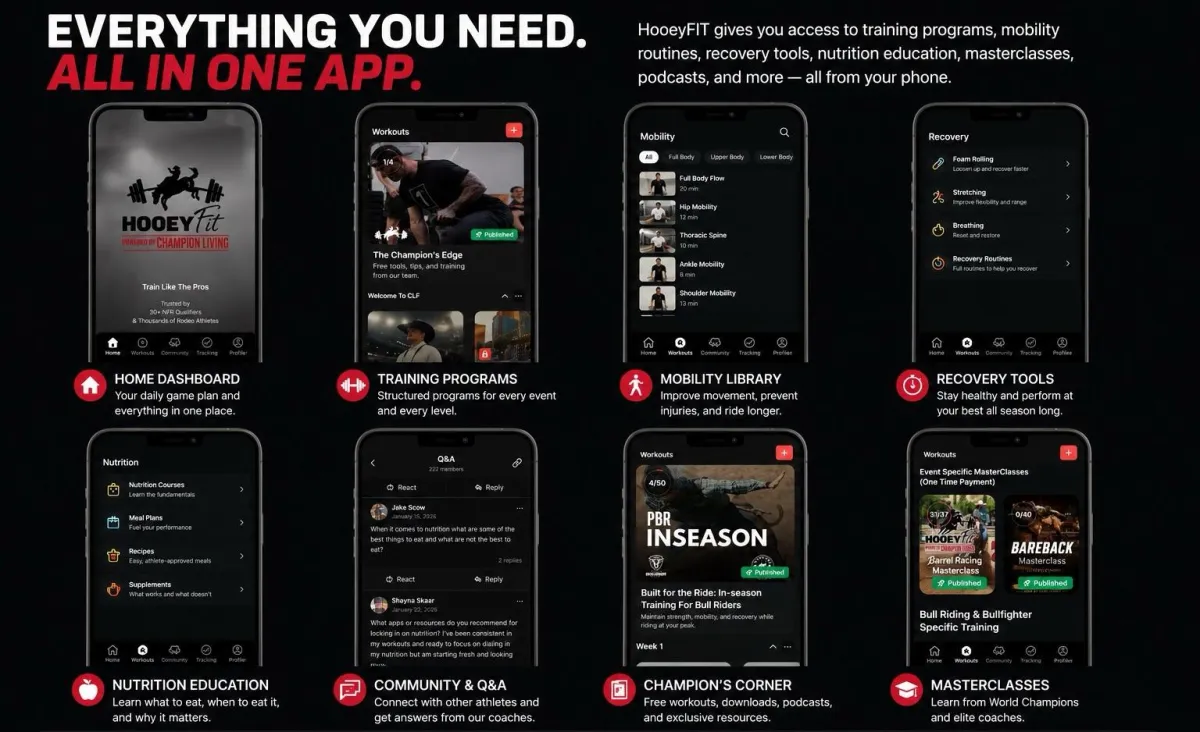
That’s a big reason HooeyFIT exists.
For that athlete, we don’t necessarily need to make training complicated. We need to remove some of the decisions. Instead of walking into a gym and trying to piece together a workout they saw online, they can open the program, see what they’re supposed to do and get to work. There’s a system behind it and a reason for what they’re doing.
For some athletes, that can take them a long way.
Eventually, another group reaches a point where they need more than a general program. Their goals get more specific. Maybe injuries are starting to affect what they can do. Maybe their travel schedule makes training difficult. Maybe they’re trying to gain weight, improve a specific physical quality or prepare for a season where the expectations are a lot higher than they used to be.
That’s when individualized coaching starts making sense.
At that point, we’re not trying to answer the question, “What should a rodeo athlete do?” We’re trying to figure out what this particular athlete needs to do.
There’s a big difference between those two things.
Now we can take their schedule, training history, injuries, nutrition, recovery, goals and everything else going on in their life and start making decisions around the individual. They also have somebody paying attention when things aren’t going according to plan, because they rarely do for an entire rodeo season. Sometimes the program needs to change. Sometimes life changes. Sometimes an athlete needs to be pushed, and sometimes they need somebody to tell them to back off for a couple of days.
Then you get to another level of development where the conversation becomes bigger than training.
This is something I probably understand better now than I did when I started Champion Living. If an athlete wants to make a real career out of rodeo, being physically prepared is only part of the job. They’re eventually going to deal with sponsors, money, media, travel, business decisions and all of the pressure that comes with trying to make a living in this sport.
That was a big part of the thinking behind the Optimal Performance Academy.
We obviously want athletes to improve physically and become better competitors, but I’ve never wanted OPA to just produce better bull riders or better rodeo athletes. I want the people who come through there to leave better prepared for everything that comes with the career they’re chasing. That means learning about business. It means understanding sponsorships. It means learning how to communicate and carry yourself professionally. It means putting young athletes around people who have already made mistakes, learned lessons and figured some of this stuff out the hard way.
When I look at Champion Living today, that’s why I don’t see a bunch of separate programs.
I see different places where an athlete might be standing.
One person might just be discovering what it actually means to train for rodeo. Another might finally be ready to follow a structured program. Somebody else might be at the point where they need a coach in their corner. Another athlete may be trying to figure out how to turn their talent into a career.
None of those athletes are ahead or behind. They’re just at different points in the process.
I think sometimes athletes get caught up believing they need to have the whole thing figured out. They want to know what the next five years are supposed to look like, what program they need, who they need to work with and exactly how they’re going to get from where they are now to wherever they want to go.
I don’t think you need to know all of that.
You need to be honest enough to figure out where you are right now, and then decide what the next step is.
Maybe that means you keep learning for a while. Maybe you finally stop winging your training and commit to a program. Maybe you know you’ve taken yourself as far as you can on your own and it’s time to get a coach involved. Maybe you’re ready for an environment like OPA where you can start working on everything that comes with becoming a professional.
The answer is going to be different for everybody, and that’s the point.
Champion Living was never built around the idea that there is one workout, one program or one path that every athlete needs to follow. It was built around helping athletes continue to develop, wherever they happen to be starting from.
I still love seeing an athlete get stronger. I still get excited when somebody hits a PR or starts moving better. I’m a strength coach. That part of me probably isn’t going anywhere.
But after doing this for a long time, those aren't necessarily the things I'm most proud of anymore.
I like watching somebody become more disciplined. I like seeing a young athlete start carrying themselves with confidence. I like watching someone figure out how to handle adversity better than they did a year ago. I like seeing an athlete start taking ownership of their career instead of waiting for somebody else to tell them what to do.
That’s what development looks like to me now.
Better athlete. Better competitor. Better human.
The training matters, but it’s only one piece of it.
Wherever you are right now, you don’t have to have the entire road mapped out. Figure out what you need next and take that step. When it’s time for another one, take that one too.
That’s really what the Champion Living Athlete Pathway is about.
If you’re trying to figure out what that next step looks like for you, you can explore the Champion Living Athlete Pathway and the different ways to work with our team at championlivingfitness.com.
Doug Champion
Founder/CEO, Champion Living Fitness