The Lower Body Workout I Give Most Rodeo Athletes
The fitness industry has made training incredibly confusing. Every time you open social media, somebody is showing you a new exercise, a new method, or a new system that’s supposedly better than everything that came before it.
If you’re an athlete trying to improve, it’s easy to start thinking you’re one exercise away from unlocking a completely new level of performance. That mindset can become a red flag, because it keeps you chasing novelty instead of building the qualities your sport actually demands.
What I’ve noticed, however, is that the best athletes I’ve worked with rarely train that way.
If you walked into the gym with most high-level rodeo athletes, you’d probably be surprised by how simple their training looks. There’s nothing flashy about it. There are no movements that require twenty minutes of explanation before you can perform them.
There’s just a handful of foundational movements done consistently over a long period of time.
That observation changed the way I coach.
Earlier in my career, I probably spent too much time trying to make programs interesting. I wanted variety. I wanted athletes to stay engaged. I wanted every phase of training to feel fresh and exciting.
What I eventually learned was that athletes don’t need more variety nearly as often as they need more mastery.
The athletes who improve the most aren’t usually chasing the next exercise. They’re getting better at the fundamentals.
When I think about the lower-body demands of rodeo, I don’t think about muscles first. I think about movement.
Can you produce force? Can you absorb force? Can you maintain position under pressure? Can you stay balanced when things become chaotic? Can you continue doing those things throughout an entire season?
Those questions matter a lot more to me than whether you’ve found the newest exercise on Instagram.
A good example is the split squat. I’ve programmed split squats for years, and every year I become more convinced that they’re one of the most valuable exercises a rodeo athlete can perform.
Not because they’re complicated, but because they expose reality.
It’s surprisingly easy to hide weaknesses when both feet are planted firmly on the ground. The moment you place yourself in a split stance, those weaknesses become much harder to ignore.
You’ll see balance issues. You’ll see mobility restrictions. You’ll see differences between sides. You’ll see stability problems. You may feel one hip working harder than the other or notice that one knee wants to cave inward when the set gets difficult.
That information matters.
For a coach, it helps identify the weakest links in your movement. For you, it creates an opportunity to improve the positions, strength, and control that transfer to your event.
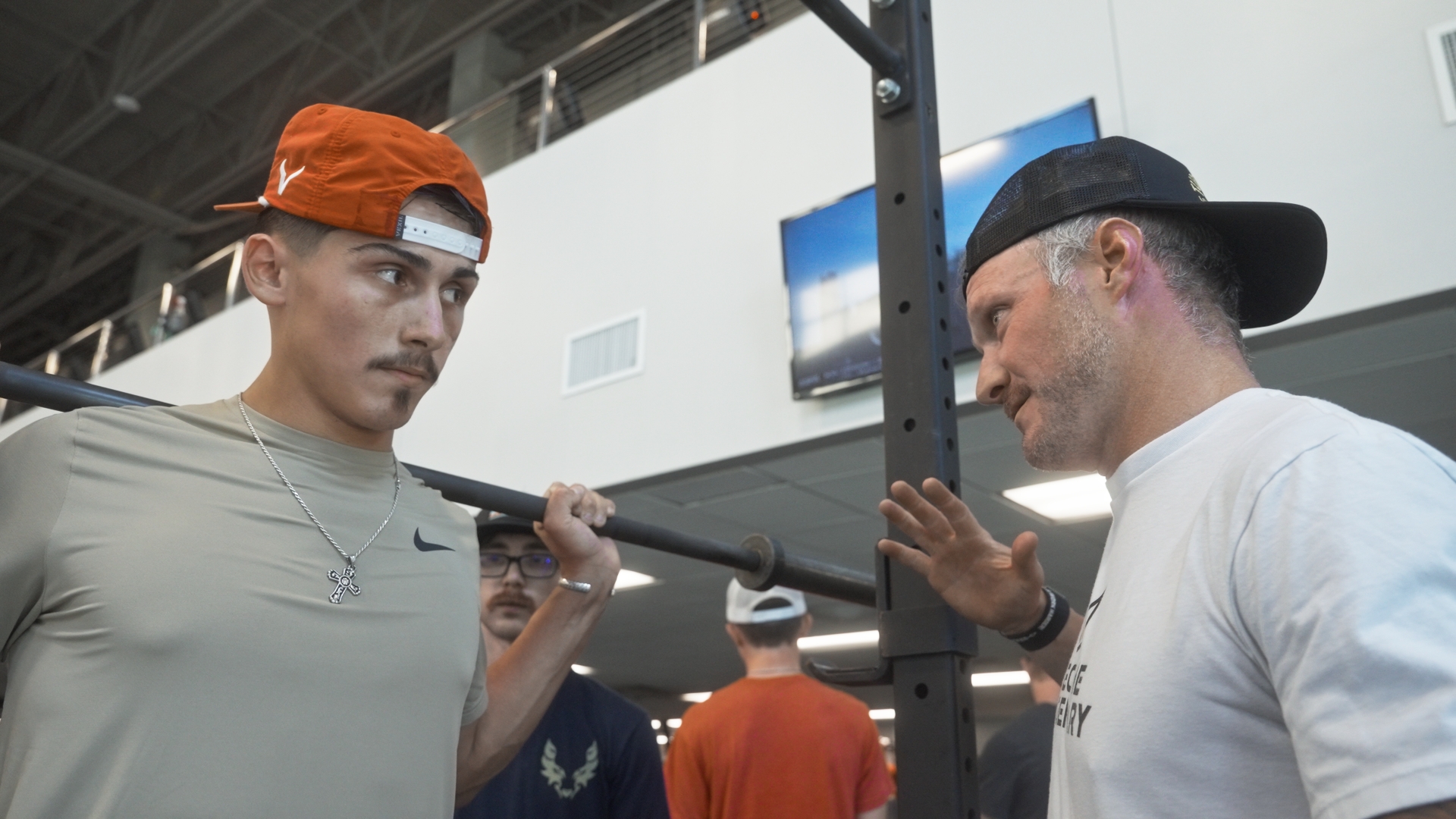
The goal isn’t to rush through split squats just to check them off your program. Own the position. Keep your front foot connected to the floor. Control the descent. Maintain alignment through your hip, knee, and ankle. Then drive back up with intent.
If your position falls apart, reduce the load or slow the movement down. You don’t need to prove how much weight you can move if you can’t control where your body is going.
The same principle applies to Romanian deadlifts, step-ups, lunges, and squats. None of these exercises are new. Most have been around for decades.
Yet they continue showing up in successful training programs because they address qualities that matter: strength, stability, control, and resilience.
Those qualities never go out of style.
Romanian deadlifts help you build strength through the glutes and hamstrings while teaching you to hinge from the hips. That matters because your hips are a major source of force production, and your ability to control the hinge helps you transfer force without dumping unnecessary stress into your lower back.
You should feel tension building through the hamstrings as your hips move behind you. If the movement feels nagging in your low back instead, your position may be off, your range may be too aggressive, or the load may be too heavy.
Start lighter. Own the hinge. Build from there.
Single-leg Romanian deadlifts can add another layer of balance and hip control. They’re especially useful when you need to identify side-to-side differences or improve your ability to stabilize while your center of mass is moving.
Keep your hips square. Avoid twisting open. Reach long with control, and don’t let the exercise turn into a competition with your balance.
Step-ups and lunges offer another valuable challenge. They require you to produce force from one leg, control your body as you move through space, and maintain position when the demands become less predictable.
That matters in rodeo because your body rarely gets to operate in a perfectly symmetrical, controlled environment. You may have to react quickly, absorb force, redirect your weight, or recover from a position that feels off.
Training should prepare you for those moments without creating unnecessary fatigue or soreness that interferes with your sport.
Squats still have an important place in many programs, too. They can help you build general lower-body strength and teach you to coordinate force through the hips, knees, and trunk.
But the exercise is only useful if you can perform it well. Chasing heavier numbers while your knees collapse, your trunk folds forward, or your depth becomes inconsistent is not productive training. It’s simply practicing a poor pattern under more load.
Train the movement you want to own.
Before lower-body training, prepare your body for the positions and demands ahead. Raise your temperature with light movement. Activate the areas that need to contribute. Mobilize the hips, ankles, and other required positions. Then potentiate the system with a few controlled, explosive efforts when appropriate.
Mobility work should not be limited to trying to achieve the biggest range of motion possible. Your goal is to own the range you need for your sport and your training. Work on mobility before training, before competition, after travel, and on recovery days so your body has repeated exposure to the positions you need to perform.
One of the biggest mistakes I see is athletes waiting until something feels tight, restricted, or downright cranky before they address it. That’s a reactive approach. A better approach is to build mobility and position control into your regular preparation.
One thing I’ve noticed about rodeo athletes is that many underestimate how much success depends on being able to repeat effort over time.
It’s not enough to be strong for one ride, one run, or one weekend. The athletes who consistently perform at a high level are usually the athletes whose bodies can tolerate the demands of the sport month after month.
That’s why I care so much about foundational lower-body strength.
It’s not because I want you to become a powerlifter. It’s because strong athletes tend to be more durable athletes. When you build strength through the hips, legs, and trunk, you create a larger reserve to draw from when the season gets difficult.
You give your body more capacity to handle stress. You improve your ability to recover. You reduce the likelihood that normal demands become major problems.
That’s what good training should do.
It should make the demands of your sport feel smaller.
If you asked me tomorrow where to start with lower-body training, I wouldn’t hand you a list of fifty exercises. I’d tell you to focus on a few movements and get exceptionally good at them.
Learn how to squat well. Learn how to hinge well. Build strength on one leg. Develop some power. Practice absorbing force. Stay consistent long enough for the process to work.
That probably isn’t the most exciting answer.
But after coaching athletes for years, I’ve found that the answers that work are often the least exciting. They’re simple, repeatable, and they hold up year after year.
You can also use implementation intentions to make that consistency easier. If you travel for competition, then schedule a short mobility session when you arrive. If you miss a training day, then return to the next planned session instead of trying to punish yourself with extra volume. If your technique breaks down, then reduce the load and finish with quality reps.
Small decisions like those keep one missed session from becoming a lost month.
The lower-body workout I give most rodeo athletes isn’t built around secrets. It’s built around fundamentals. Because long after trends come and go, the athletes who continue improving are usually the ones who never stopped doing the basics well.
And in my experience, that’s where great training begins.
If you’re ready to take the next step in your Champion Living Athlete Pathway, let’s get you on a call with a coach to see if you’re a good fit for our Individualized Coaching.
Start with the basics. Master your positions. Build the strength that allows you to perform, recover, and stay in the game for the long haul.
Your Coach,
Doug Champion