If You're Starting Your High School Rodeo Season, Don't Make This Mistake
Your First Rodeo Is Coming: 3 Things to Do Before You Start Riding More
Your first rodeo is coming up? Don’t just start riding more and call that getting in shape.
That is one of the easiest mistakes a young rodeo athlete can make. The season gets closer, nerves start showing up, and suddenly you are trying to ride, rope, or practice your event every day because you think more exposure will automatically prepare you.
Practice matters. Experience matters. But riding more does not replace conditioning, strength, or recovery.
Every ride takes something from your body. Your lungs work. Your legs work. Your trunk has to stabilize. Your hands, shoulders, hips, and back absorb stress. If you go from very little activity to riding or roping every day, you may show up to your first rodeo already tired, sore, or moving poorly.
The goal is not to see how much work you can survive for two weeks. The goal is to build a body that can handle the demands of the season and continue improving after the first rodeo is over.
Start with these three priorities.
The first thing you need to do is prepare your lungs for short, hard efforts.
Rodeo events may be brief, but brief does not mean easy. A ride, sprint down the arena, or hard roping effort can demand a lot from your heart and lungs in a short amount of time. If you are not used to those efforts, you may feel gassed before your body has a chance to do what you trained it to do.
You do not need to run long distances every day. You need to build the ability to produce effort, recover, and produce another effort with better control.
Start conditioning two or three days per week. Keep the sessions short and focused. You might use sprint intervals, a bike, a rower, hill efforts, shuttle runs, or another option your coach approves.
For example, begin with a simple session that includes a short warm-up, followed by several hard efforts lasting about 10 to 20 seconds. Rest long enough to recover before repeating the effort. As your fitness improves, gradually add a few repetitions or slightly increase the work time.
Do not turn every conditioning session into a test. The purpose is to prepare your energy systems, not to leave yourself wrecked for the rest of the week.
If you are younger or brand new to structured training, focus on movement quality and control. Sprint with good mechanics. Change direction under control. Learn how to slow down before trying to move faster.
You should finish most sessions feeling like you trained, not like you need to be carried to the truck.
The second thing you need to do is build simple, useful strength.
You do not need a complicated program filled with exercises you have never heard of. You need to become stronger in the basic movement patterns your body uses every day and in your event.
That means learning how to squat, hinge, push, pull, and carry.
Squatting helps you develop leg strength and control. Hinging teaches you how to use your hips while protecting your back. Pushing and pulling build upper-body strength for handling equipment, controlling position, and staying connected to the movement around you. Carries challenge your grip, trunk, posture, and ability to maintain control while moving.
Strength training two or three days per week can make a major difference when it is coached and progressed appropriately.
Start with movements you can perform well. Bodyweight squats, goblet squats, hip hinges, light deadlift variations, pushups, rows, band pulls, and farmer carries can all be useful starting points. The exact exercise is less important than learning how to perform it correctly and consistently.
Do not chase heavy weight just because somebody else is lifting heavy. A high school athlete who can control a movement, brace their trunk, keep their knees and feet organized, and repeat quality reps is building a better foundation than an athlete who constantly adds weight while their technique falls apart.
Ask your parent, coach, or qualified strength professional to help you choose the right load. Leave room to learn. Strength is not built by turning every workout into a competition.
Your event also determines what you need to emphasize. A bull rider may need to develop trunk strength and the ability to resist rotation. A bareback rider needs the strength and capacity to maintain position while fatigued. A roper needs lower-body strength, coordination, trunk control, and repeated-effort capacity.
You do not need to solve every weakness in one workout. Build the foundation first, then let your training become more specific over time.
The third thing you need to do is practice your event while gradually building your reps.
This is where many athletes get impatient. They go from zero to riding or roping every day because the first rodeo is getting close. That approach may feel productive at first, but it can create a nagging soreness problem, poor technique, and fatigue that makes every repetition worse.
Practice is only useful when you can learn from it.
If you are tired enough that your position is falling apart, your timing is late, or you are repeating the same mistake, more reps may not be helping. You may simply be practicing bad movement under fatigue.
Start with a manageable amount of event-specific work. If you have not been practicing consistently, do not begin with daily exposure. Give your body time to adapt.
You might practice your event two days during the first week, then add a third session when you are recovering well and maintaining quality. The next week, you could add a small amount of volume rather than suddenly doubling your work. Your coach can help determine whether that means more rides, more dummy roping, more drills, or more time working on position and timing.
Use the simplest progression possible: increase one variable at a time.
You can add a few reps, a little more time, or a slightly more challenging situation. You do not need to increase everything at once. If you add more rides, keep the rest of the session controlled. If you increase intensity, keep the total number of reps lower.
Quality comes before quantity.
Your first rodeo should not be the first time your body experiences a hard effort, a long day, or the pressure of performing in front of a crowd. Prepare for those demands without trying to recreate the entire season in one week.
Build in rest. At least one or two days each week should be easier, depending on your age, training history, school schedule, and total activity. Remember that football practice, basketball, baseball, farm work, PE class, and other activities all count toward your workload.
Parents, this is where your perspective matters. A young athlete may say they feel fine because they are excited and do not want to miss an opportunity. Pay attention to changes in sleep, mood, appetite, motivation, and movement quality.
If your athlete is unusually sore, constantly tired, moving differently, or dealing with pain, do not automatically add more work. Stop and communicate with the coach or a qualified medical professional. Pain is not something an athlete should be expected to push through just to prove they are tough.
Normal training discomfort and pain are not the same thing. Muscle fatigue can be part of a workout. Sharp pain, joint pain, worsening symptoms, numbness, or pain that changes how you move should be taken seriously.
Use a warm-up before every conditioning, strength, and event session. Get your body temperature up, move through the ranges your event requires, and perform a few easier practice efforts before going full speed. Afterward, walk, breathe, hydrate, and give your body a chance to come down.
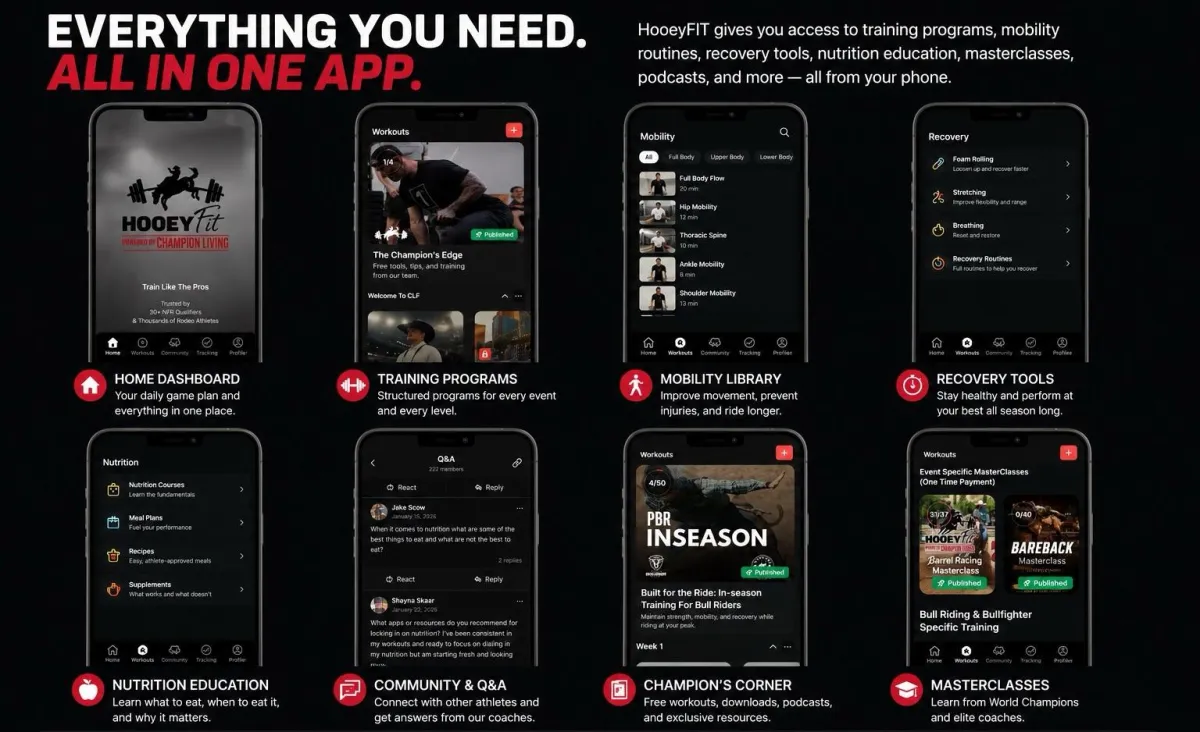
You can also use the HooeyFit app through Champion Living Fitness to access structured training programs, mobility and recovery routines, nutrition education, event-specific masterclasses, and other performance resources.
The best pre-rodeo plan is not the one that makes you feel the toughest for a few days. It is the one you can repeat week after week.
Condition two or three days per week. Strength train two or three days per week. Practice your event consistently, but build your reps instead of going from zero to every day. Rest before you are forced to rest.
If you only have a few weeks before your first rodeo, do not wait for the perfect plan. Start now. Keep the work simple, make each session purposeful, and involve the people around you who can help you make good decisions.
You are not trying to prove that you can survive the most punishment. You are building the capacity to perform, recover, learn, and come back ready for the next opportunity.
Get your body ready before the season beats it up. Start with the basics, build gradually, and let your preparation give you confidence when it is time to compete.
If you want training gear that represents the work you are putting in, shop the Champion Living x Hooey collection.
Start now. Train smart. Show up to your first rodeo prepared to perform, not just hoping that more riding will get you in shape. Set up your Consultation With A Champion Living Expert Here!